Status Reports Must Die ... and I’m Handing You the Harpoon!
I’ve been on a kick to re-read the classics, and in doing so, I finally realized the whale I was born to chase! My particular snowy leviathan takes the form of project status reports and believe me I intend to fling a (metaphorical) harpoon and slay this “insufferable foe”, at least in its current, excruciating form.

Now, you may be asking “Why focus your time and energy on such a painfully boring subject?” Well, it’s because I’m aggrieved by how much time I’ve spent in tiresome status update meetings. Too many times, I’ve had to wait 45 minutes just to say, “Nothing from my end.” And as a manager, I’ve hated every “So ... how’s it going?” conversation, which I’ve needed to have every week with everyone on my team.
And if that’s not bad enough, after that I still had to decipher what the hell my teammates actually meant by “Fine” or “OK”!
But more importantly I want to kill status reports because they just don’t work. They routinely fail at their most important job: surfacing trouble while there is still time to act. Leaders still get blindsided by missed deadlines or compromised deliveries, and team members are left paying the price in fire drills. This is far too common an occurrence (and is well documented). What is particularly galling is that often people on the team know the problem is coming in advance.
Every project management tool has some “status” component. Many software teams hold daily standups, weekly status meetings, and may use agile or kanban boards. Then there’s the new breed of Developer Productivity Insight Platforms (DPIP), and that’s not even considering the updates scattered across Slack and Teams channels and emails.
So, why, with all these tools, and whatever new AI enablement you’re playing around with, is it still not easy to keep our fingers on the team’s pulse? I believe there are three main reasons.
First, we keep condensing and filtering the team’s feedback. Insight from 5 engineers becomes 1 team leader’s update. Insight from 4 team leaders becomes 1 project manager’s update. Reports from 3 or 4 project managers then get filtered at the director level. At each step the manager is subject to several recognized biases that can soften the signal. This is how you end up with watermelon reports (green on the outside, but red in the middle).
Second, the reason the existing tools fall short is because most project status data is scattered across multiple systems and it gets stale quickly. It’s also really difficult to consistently filter through the noise to get to the real signal. The newer DPIP offerings measure output, but output alone doesn’t capture the team’s perspective or whether they believe they can meet the deadline.
Third, we’ve lost many of the informal channels. Engineering leaders still have 1-on-1s and skip-level meetings, but with remote and hybrid work there are fewer hallway conversations and watercooler discussions—so we are missing those unscheduled moments when someone on the team lets slip a concern that never made it into the status report.
That’s why we built Genchi: to remove the filtering between the people doing the work and the people making decisions, to give leaders a single, current project delivery prediction instead of scattered, stale updates, and to recapture the hallway signal that remote work took away.
We can’t eliminate problems, but we can make them easy to raise and surface them early enough for leaders to act to avoid bad outcomes and make delivery more predictable.
To do that, we’ve harnessed the “wisdom of crowds”: a rolling prediction, straight from the people doing the work, of which projects are at risk of missing their deadline and which aren’t.
Drawing inspiration from the standup “thumb check” and the SAFe “Fist of Five” confidence vote, we give every engineer an easy way to be heard, via an anonymous, one-click confidence vote in response to a regular, automated Slack prompt:
How confident are you that the team will achieve [GOAL] by [DEADLINE]?
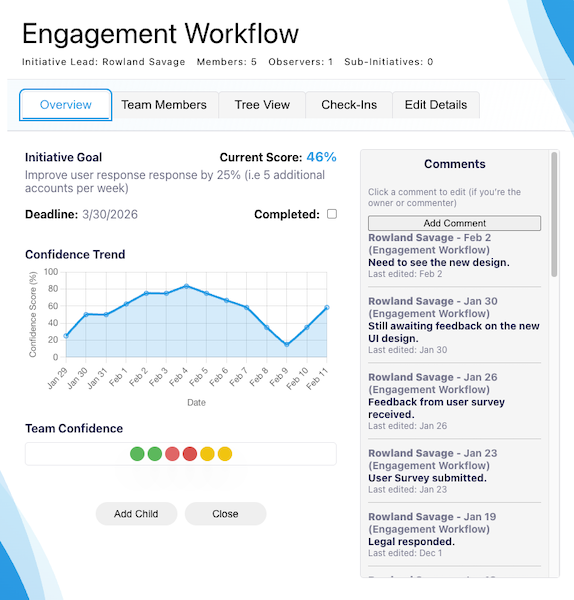
Leaders can see the individual vote values on a 1-5 scale (anonymized to encourage candor) as well as the combined score for each project, tracked over time. So, an abrupt change in individual confidence votes or a collective ebb in the team’s confidence is visually apparent at a project and portfolio level. Leaders can spot projects getting into trouble sooner and step in where needed. And, perhaps more importantly, see which teams to leave alone.
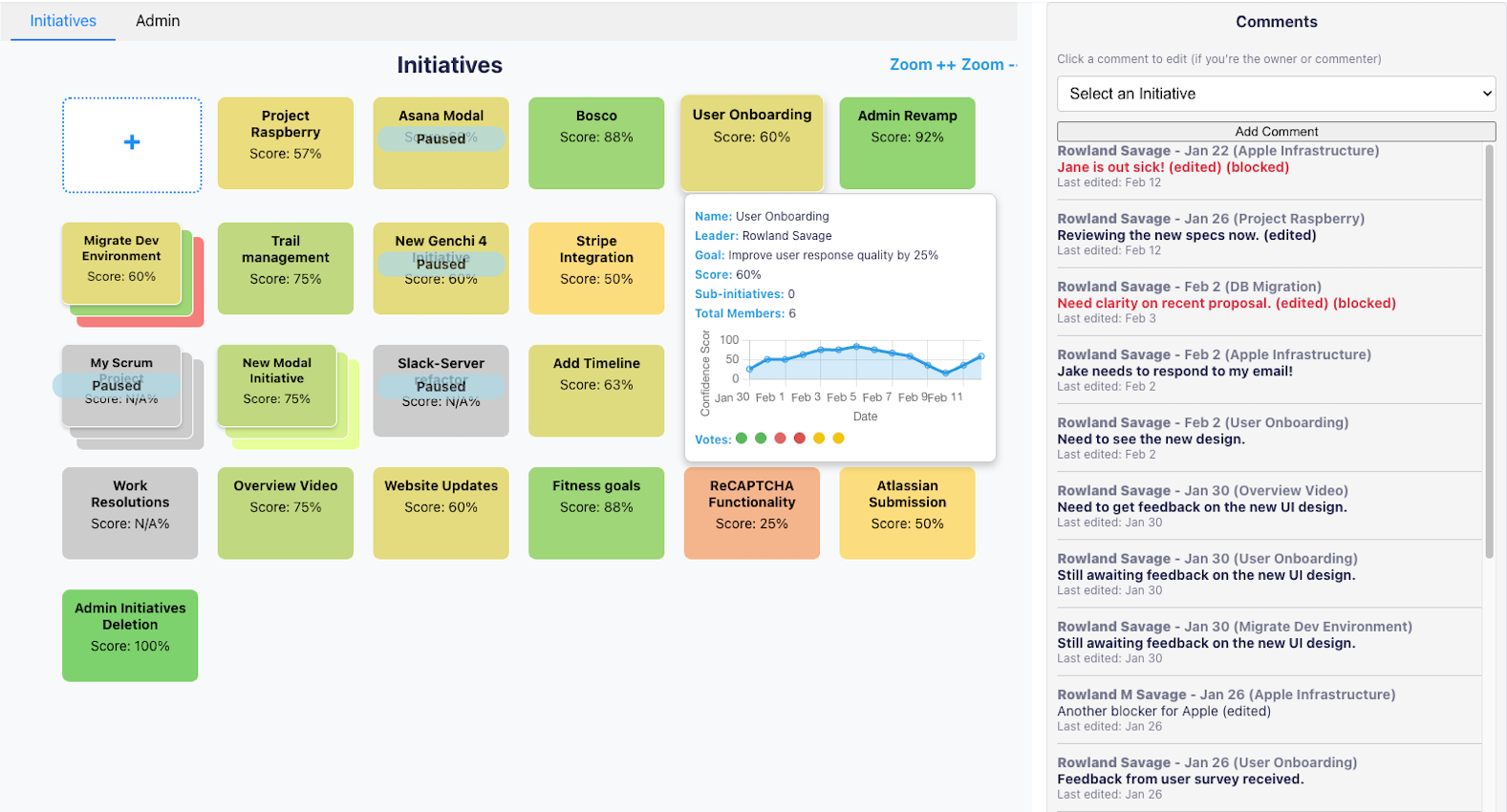
The team members in turn get visibility into how their teammates are seeing the project and how the teams they depend on are doing.
Genchi turns the existing infrequent, filtered status report into a regularly updated project delivery prediction, straight from the people doing the work. Ambiguous “Fine” and “OK” responses are replaced by a consistent, quantified signal, and the weekly round of “so… how’s it going?” check-ins is replaced by a shared view that keeps engineering leaders and team members in sync on deadlines.
Check out Genchi.com for more details. Pick an active project, connect Slack and run Genchi for free for two weeks. Find out whether the people doing the work are as confident in the deadline as the status reports suggest.
In the meantime, I’m going to keep pursuing this white whale. Status reports have taken enough of your time. Here’s your harpoon.
Sources
- Haystack Analytics (2021). 83% of developers suffer from burnout, Haystack Analytics study finds. Press release.
- Project Management Institute (2021). Pulse of the Profession 2021: Beyond Agility.
- Geneca (2011). Doomed from the Start? Why a Majority of Business and IT Teams Anticipate Their Software Development Projects Will Fail. Press release.
- Snow, A.P., Keil, M. & Wallace, L. (2007). The effects of optimistic and pessimistic biasing on software project status reporting. Information & Management, 44(2), 130–141.
- Watermelon projects. ProjectManagement.com.
- Scaled Agile, Inc. PI Planning. Scaled Agile Framework.
Replace the Status Report with a Project Delivery Prediction
1-click per person, aggregated into a current read of every project.
START FREE TRIALFree for teams under 10. $2.50/user/month after that (~$250/month for a 100-person org). No credit card to start.